Tuesday, October 17, 2006

New Book Explores
Watergate Tag Team

Two weeks ago, a couple of mastodons appeared together on CBS's 60 Minutes, doing what they do best.

Mike Wallace was interviewing Bob Woodward, kicking off the usual publicity blitz over the latter's latest book about Beltway intrigue. Only this time, some of the thunder was stolen by the New York Time's front-page, embargo-breaking revelations about the book two days earlier.

Woodward and Wallace are quite a pair. The latter pretends to be a trenchcoated tough guy reporter, when in truth he mostly reads others' scripts and relies on producers, assistants who do the real reporting while he tends to his pancake makeup (Woodward deliciously pulled back the curtain on all this fakery during the interview, by noting that he had earlier played his tapes "for your producers," in other words, for the people who did the real work of preparing for the interview).

As for Woodward--well, at least he had a glorious past. His reputation has lately taken some major hits, and deservedly so, for the way he has credulously come to be a transmission belt for official Washington. After two earlier, largely admiring books about the George W. Bush White House, he has finally figured out the truth in this capper of his George W. trilogy. Stop the presses, he screams: this White House has been putting a pretty face on a war in Iraq that's actually going poorly. He presents this with his signature poker face, apparently unaware that most of the rest of the world figured this out quite some time ago.

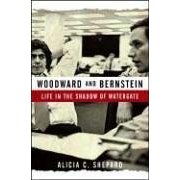
Just when you thought you've had enough of Bob Woodward's smarmy insiderism and stenographic "insights" into Washington officialdom, a timely new book comes along to remind you that he wasn't always this gullible. He and sidekick Carl Bernstein first came to prominence decades ago during Watergate for pursuing their subjects in quite the opposite fashion: by ignoring the access game and the seductive lies that powerful people tell, and instead slowly piecing together the real story. But the book, Woodward and Bernstein--Life in the Shadow of Watergate, by journalism professor Alicia Shepard, is ultimately disappointing. That’s in part because so much of this ground has already been plowed--both more deeply and in a far more stylish way--many years ago by David Halberstam, in his magisterial The Powers that Be.

Still, it’s interesting to see how the partnership has played out ever since. The core of the story remains the wonderfully, even comically, mismatched pair of reporters. Bernstein, the product of New York Jewish radicals (whose own bar mitzvah, he would later learn, had been infiltrated by the FBI), a dashing writer with a short attention span and a zest for the A-list New York night life that routinely lands him in the gossip columns (his response over the years has been to give dozens of speeches, at $15K a pop, about how trashy the media has become). And Woodward, the bland Midwestern Naval veteran, a clumsy writer but a reporter of ferocious stamina, whose home office is rightly called "The Factory." As the notes of the director of All the President's Men put it: “Bernstein fit the naughty boy syndrome, and Woodward fit the good boy syndrome—but they needed each other.”

Shepard adds much new material, some of the most interesting of it culled from her patient search of the pair’s massive Watergate files, notes and other material they sold three years ago to the University of Texas library for a cool $5 million. Shepard uses the material to good effect, reproducing generally unanswered mash notes from female fans and telling details of their one-time business arrangements (in 1977, they closed the joint bank account they had used until then for movie and book rights, signaling a long cooling-off period in their friendship). She also adds a fresh look at Woodward, whose "Cheneyesque sense of absolute authority and calm," in the words of his Post colleague Bob Kaiser, has been put in the service of one bestselling book after the other. His curious arrangement with the Post, meanwhile, which lets him mostly keep his bombshells for his books, has earned him the envious newsroom nickname Mr. Carte Blanche.

She quotes David Gergen's take on Woodward: 'There's both a psychological quality and an empathic quality to him,' said David Gergen, who has known Woodward since Watergate and has fallen under his spell while working for the Nixon and Clinton administrations. 'He provides peopole withthe sense of safety, that somehow, if you tell him, it will be reported straight, straighter than anyone else. He is able to bond with people in a way that most journalists can't. There's a pschological bonding tha tgoes on. He's very good at putting himself in the minds or shoes of others. But you've got to know before you sit down with Bob Woodward how far you are willing to go with the information. He's very seductive.'

While the recent unmasking of Deep Throat ends a 33-year-old mystery, Shepard points out its lasting importance for journalism. “Deep Throat was not just a quixotic mystery. His debut in 1974 changed journalism, because he lent credibility to the notion of using anonymous sources. Through their rigorous reporting, which relied so heavily on confidential sources, Woodward and Bernstein succeeded in popularizing the use of anonymous sources.” Of course, that has also occasionally had disastrous results, including for Woodward himself. His goal of succeeding his mentor Ben Bradlee as editor of the Post ended with the Janet Cooke affair, in which the Post had to return a Pulitzer for a fictional story of an eight-year-old heroine addict.

The book nicely documents the slow dance over the movie that sealed the pair's gigantic fame. Woodstein agreed to do it only because they trusted Robert Redford, who at the time was fresh off his movie The Candidate, which took a hard outsider look at the cynical world of electoral politics. At first, he imagined what later came to be All The President’s Men as a no-star, black-and-white documentary on investigative reporting.

"Redford promised to make a serious movie about reporting—not a Hollywood, flashy move about the shifty Watergate figures surrounding Nixon or a screwball comedy about newspapering," Shepard writes. "Woodward and Bernstein wanted a movie that would honesty portray reporters. Redford had no intention of glamorizing either them or investigative reporting. He wanted to educate the public about the rigors of investigative journalism; to show how meticulous reporters need to be, how many dead ends they pursue, and how repetitive, sometimes downright boring, investigative reporting could be. Yet there also needed to be an element of comic byplay."

In the end, of course, the movie did indeed glamorize both the reporting pair and their craft. It touched off an immediate wave of interest in journalism school that in certain ways could be said to continue to this day. But the movie also had an ironic twist for the two men. Shepard writes that after the movie, “the names Woodward and Berstein were famous, but their faces had morphed into those of Redford and Hoffman. In a small way, they had gotten back some of their anonymity.”

Woodward and Bernstein will remain famous names for as long as people recall newspaper journalism and American politics. That's what happens when you help topple an American president near the apex of the American Century.

Sunday, December 30, 2007

Sunday Stuff

What follows is a roundup of stuff I thought important to notice, but which I don't necessarily have the time to delve into in a larger way just now. But don't be shy, dear reader. If any of these happen to hit your interest button, please do pipe up and comment to get the conversation started.

Why We Love Bookslut, Part 67. How can you resist a blog that's as lively and earnest as the writing in this entry, from Bookslut's 20-something Jessa Crispin, posted on Dec. 18th: "Back when I was 19 and an idiot, I was very swoony for Glenn Gould. Not as swoony as the girl I knew in Canada who went to his grave and wept, saying she had no hope for love because only Glenn Gould would ever really be able to understand her, but still about as swoony as some girls got over Morrissey. (Never understood that one, myself.) And let's not think about the fact that I've switched my dead guy crush from Gould to William James, who was also not in the best of health, but at least he didn't have the weird scarf thing." We've enthused about the Chicago-based literary blog earlier--here, here, here, here and here.

Hollywood Producer Peter Guber on the Importance of Storytelling. Though it's not available online for nonsubscribers (and it's among the priciest pubs on the planet), this piece in the current Harvard Business Review is worth finding at the bookstore or library. Here's how it begins: "The power of storytelling is also central to my work as a business executive and entrepreneur. Over the years, I've learned that the ability to articulate your story or that of your company is crucial in almost every phase of enterprise management. It works all along the business food chain: A great salesperson knows how to tell a story in which the product is the hero. A successful line manager can rally the team to extraordinary efforts through a story that shows how short-term sacrifice leads to long-term success. An effective CEO uses an emotional narrative about the company's mission to attract investors and partners, to set lofty goals, and to inspire employees. "

Speaking of Hollywood...Looking for a fresh take on the writer's strike, which next week will enter its third month? I'd recommend this piece in the lively lefty journal In These Times. I learned some things from this piece that I've seen nowhere else, including the fact that the Writer's Guild used to represent about 95% of those who write for film and TV, but that cable and reality shows have helped whittle that down by about half, to 55%. The author argues that the growing concentration of corporate ownership has allowed these deep-pocketed companies to ride out strikes their predecessors couldn't.

Stop the Presses: Rich Districts Produce Good Schools. Solon and Chagrin Falls high schools are ranked #s 126 & 127 in Newsweek's new listing of the top 1,300 public high schools in the U.S. They had the top slots for this region (a couple of Cincinnati-area schools were in the top 100). Then again, I have about as much faith in these kinds of lists as I do in energy healing and Cleveland magazine's annual "rating the suburbs" feature. In other words, not much. (So why even mention it, you ask? Because we believe in the bedrock principle of we report, you decide!)

CIO Magazine on how Wal-Mart Lost its Technology Edge. CIO, owned by the same company that publishes Britain's stately and authoritative Economist, is a great and often-overlooked pub, the kind that often serves as both a feeder system and crib notes for larger, more prominent news organizations. Anyway, since technology has always been the crucial factor in this omnivorous company's rise, I found this piece about Wal-Mart's waning tech edge to be of special interest, and you might too. Here's a prediction: you'll soon see this same theme cropping up all over the rest of the media, in many cases mostly just repackaging of this piece, with perhaps a little different slant and a sprinking of additional reporting. In fact, we just may consider awarding a prize to the first reader who can provide such a link. By the way, for non-techie readers, CIO stands for chief information officer.

Monday, December 06, 2004

Catch-Up Day

I was a blogging laggard last week, and so it's time to make up for lost ground. So here we go...

Newsweeklies Struggle for Relevance. With the imminent retirement of two out of three of the longtime TV network anchors, the focus has been on how the telenetworks are becoming increasingly irrelevant. But I think an equally interesting, though far less-examined, phenomenon is how the major weekly news mags are dealing with those same forces of more competition and declining relevance. For decades, there were three dominant networks AND the same number of newsweeklies--Time, Newsweek and US News & World Report. The latter mag has pretty well fallen by the wayside--for all practical purposes, I think it essentially ceased to be a factor after its failed experiment with letting a serious editor, Jim Fallows, try to revive it into something worth reading. Since he was let go in 1998, it's mostly fallen off the journalism radar screen, except for its splashy annual college rankings and some lingering attention paid to its owner Mort Zuckerman and its conservative columnist John Leo (a poor man's George Will). But Time and Newsweek continue to scrap it out, running eerily similar cover stories and photos most weeks. This week, they're evidently hoping to catch the Red State spiritual zeitgeist in the run-up to Christmas, though with a twist that they probably hope allows them to retain a morsel of Blue State respectability: they're both fact-checking the Biblical story of Jesus' birth in cover stories, concluding (stop the presses!) that the literal story is interwoven with some myth. I ask you: Do we really need two magazines to do this kind of stuff?

Here's a big moment for Amazon.com: For the first time ever, the online retailer is selling more consumer electronics than books. Which must be sweet news indeed for its visionary founder, Jeff Bezos, who has stubbornly insisted for a decade, through both extreme highs and lows in his stock price that he wasn't concerned about how the stock was doing but was instead intent on building what amounted to the Wal-Mart of the web. Once millions of shoppers were comfortable with the system, selection and service he offered, he reasoned, there's no limit on what he might sell them. Which appears to finally be proving true. Good for him for sticking it out over the long haul.

Pekar the Pack Rat. A few months ago, I finally did the unthinkable. After years of inertly muttering assent to my wife's pleas to go through the giant piles of magazines I've accumulated and throw out what I no longer need, I finally went ahead and did it. Of course, only hardened magazine lovers can appreciate that the choice of which magazines you'll "need" is a meaningless distinction. And of course writers always have the built-in excuse that you never know what factoids you'll need to consult later for some as-yet-unimagined article. Anyway, it was with a mournful attitude that I began going through them, making decisions that amounted to a kind of Sophie's Choice, deciding which of your offspring to save from death. Should I keep those GQ's from the early and mid-'90s with the brilliant reporting and writing as a sad reminder of what it once was before it chased the so-called "lad mags" downmarket? How in hell can I possibly pitch that New Republic from the late '80s with its cover piece by the future right-wing hit man Fred Barnes (now of the Weekly Standard and Fox News)? I see from this piece that Cleveland's most famous former file clerk, Harvey Pekar, hasn't yet succumbed to his wife's entreaties for domestic tidiness. And so his piles grow ever larger. Good luck with your struggle, Harv. As a fellow clutter addict, I can tell you there is life after one pares his piles. But there's no getting around the fact that it's likely to be a slightly more vanilla existence...

Le Monde Gets Behind Blogs in Big Way. For the most part, U.S. newspapers are still mired in tired, hyperdefensive debates about how blogging will never replace, much less supplement, mainstream journalism. Meanwhile, France's most distinguished paper, Le Monde (which bore that famous headline "We are all Americans" after 9/11) is offering to set its readers up with their own blogs. No word yet if John Kerry, alleged by the Republicans to be secretly French, will take them up on the offer.

Washington Monthly Rolls On. Some longtime fans of America's greatest overachieving, underfunded little political magazine, D.C.-based Washington Monthly, might have worried that it would never survive the retirement of its founder, the cantankerous former JFK aide Charlie Peters. He built a legend for hiring squads of young journalists for peanuts, proudly watching as they later became stars in the upper reaches of the profession (fittingly, the offices at Dupont Circle were, and perhaps still are, near America's best muckraker, Sy Hersch). His alumni group reads like a who's who of serious long-form journalism in America: former TNR editor and Slate founder Michael Kinsley (newly installed as editorial page editor of the L.A. Times), Newsweek's Jonathan Alter, historian Taylor Branch, Fortune's Joe Nocera, environmental contrarian Greg Easterbrook, Slate's Tim Noah and Columbia J-School dean Nick Lemann, among many others. Anyway, despite the fact that he turned over the reins (though he still writes his "Tilting at Windmills" column), it seems the magazine is doing just fine recently. Not long ago, it converted its website to a fine blog, thus far a unique development among print mags. And this sparkling December cover profile of Bob Novak, whom I've mentioned recently, shows the print companion continues to perform solidly as well. Take a bow, Charlie Peters, and keep tilting away...

Your Tax Dollars at Work. A couple of weeks ago, I mentioned the wasteful federal spending that is sneakily stuffed into bills through last-minute horse-trading, including the silly $300,000-plus earmarked for supposed educational programming for the Rock Hall (to my knowledge, no local mainstream media outlet has yet picked up on that little tidbit). But of course the real outrage is larger, deeper and more structural. Bush, Jr. came into office grandly talking about taking a razor to wasteful farm subsidies, which are indeed scandalous. But since his 2000 campaign, there's been scarce followup. Meanwhile, the rip-off of the U.S. Treasury continues. This online database, from the generally reliable enviro lobbying group Environmental Working Group, tracks all the dollars in stunning detail. It shows, for instance, that federal subsidies to just one state (Ohio) for just one commodity (corn) totaled just over $1.7 billion between 1995-2003. And remember: some of these subsidies are for price supports. Which means the government pays farmers not to plant various crops, so as to maintain high prices for other farmers. Read through some of this and weep. Only make sure you haven't just eaten, cause it may just induce vomiting.

Cleveland's Own Thundertech. I've occasionally mentioned in these pages one of the region's best young entrepreneurs, my friend Jason Therrien of the web-development shop Thundertech. He's been a real leader of the town's youthful change agents, talking up the benefits of the Creative Corridor here and playing a key role in getting probably the best of the local young professionals groups off the ground here. And after a recent move from Payne Avenue and E. 40th to larger Midtown Corridor studios, the thriving company may soon outgrow that space as well (but he tells me they'll probably be able to tear down some walls for future expansions). These days, the former Inside Business cover boy is hopeful that Thundertech (named for a time when he was a tad heavier and running over defensive linemen as a JCU running back) will get its second bit of national attention (he was already quoted this month in Ad Age). Thundertech has made it past the first round of cuts for Fast Company Mag's annual Fast 50 competition. You can read his submission here on the magazine's website. If you know him and/or his shop's fine work, please consider leaving a comment on the page, as I plan to do soon.

Finally, this latest bit of Bush Administration idiocy. I wrote recently about the concerns over the falling U.S. dollar, and how having a Treasury Secretary who is an economically unsophisticated former railroad president (John Snow) with little or no credibility on Wall Street or in the bond market is only making matters worse. So what does this band of incompetents do? In recent days, they've begun leaking news that they do indeed want Snow out, only to be replaced, apparently, by someone who has even less of a background for the job: current White House chief of staff Andy Card. His chief credentials consist of being a longtime Bush family retainer and an auto industry lobbyist during the Clinton years. Now, that will calm the financial markets. The ever-astute New Yorker economics writer John Cassidy said it best last week: "Ultimately, the value of a currency is an international verdict on the honesty and competence of the government that issued it. President Bush may have recovered in the domestic polls, but in the currency markets his ratings are still falling." And you, along with your children and your children's children, will pay for it. That is, of course, if you haven't already been bankrupted by those payments to farmers who agree not to plant their crops.

Saturday, April 26, 2008

Saturday Stuff

Best Headline of the Week. From the British paper The Telegraph:
"Polygamy Doesn't Work, Says Father of 77."

Consumer Reports Does it Again. Last week,
we ridiculed the silliest "coverage" of Earth Day. So we owed you the opposite. The best of the bunch, we thought, was this comprehensive Earth Day Guide from Consumer Reports. Simply sublime.

Thuggish Scalia Goes Public to Plug His Book. If I could still be shocked by anything our thuggish federal government does, one of the most shocking things would be that a creep named Antonin Scalia could actually sit on the Supreme Court. Scalia (who spent a few years in Cleveland, working for the law firm Jones Day) is so disdainful of democracy and of democratic traditions that he really would be a better fit to preside over a court somewhere in a banana republic, where his creepy views and thuggish tactics wouldn't stick out so obviously. The Reuters news agency
notes that the famously private justice, whose security detail once forced reporters to erase the tape they made of a public speech he gave (it would have taken about five of them to hold me down for that), is now opening up with the media. Why? He happens to have a new book out. Here's hoping the public will treat his book the same way he treats the public.

Okay, I Admit It: I'm Shallow. I would have loved to attend this presentation the other night. Wilson is a first-class thinker and writer on a crucial topic, probably the leading authority on the issue of urban poverty. But it would have meant missing part of the Cavs playoff game. Sorry, but that's simply not going to happen. For my penance, I've assigned myself the task of reading/listening to a few articles by and interviews of Dr. Wilson (if you'd like to do the same, you could start with this, this and this). Eventually, I hope to read his classic book.

Okay, I Admit It: I'm Shallow (Part 2). Rush Limbaugh famously observed on his idiot radio show, in a knock on the idea of electing Hillary Clinton, that Americans don't want to watch a woman age in the White House. Perhaps Hillary could take a page from German Chancellor Angela Merkel, who recently wore a dress with an alarming (for some people) abundance of decollatage for a world leader. It apparently received considerable media attention. I thought it was wonderful, though. She'd get my vote. But I wouldn't hold my breath waiting for Hillary to duplicate it any time soon.

Doing What Wild Animals Tend to Do. I loved this small detail from a Los Angeles Times
account of the tragic killing of an animal trainer by a 700-lb. bear used in several Hollywood films. "For unknown reasons, the bear lunged at 39-year-old Stephan Miller..." Unknown reasons? How about the fact that it's a wild animal doing what nature groomed it to do?

Stop the Presses! Party girl
Jenna Bush may not support McCain for president. Gosh, can his campaign ever survive such a blow? After all, who has more moral authority than she?

Finally, NPR's Michael Feldman got off a good joke this morning. During a riff about the Texas polygamist clan, he noted that the state is being forced to decide whether the children have been abused. After all, their knowledge of the outside world is so spotty that they didn't know who the president of the United States is. He concluded with the observation that "it's the state's burden to show why that's a bad thing."

Tuesday, October 13, 2009

Stop the Presses!

'Contrary to the hopes of some advocates, the internet is not changing the socioeconomic character of civic engagement in America. Just as in offline civic life, the well-to-do and well-educated are more likely than those less well off to participate in online political activities such as emailing a government official, signing an online petition or making a political contribution.'
--a conclusion from the most recent "no-duh" report assembled by the Pew Internet organization, producers of a series of studies that point out the painfully obvious. You can review earlier iterations of our Stop the Presses series here.

Wednesday, March 03, 2010

Stop the Presses!

The Canadian Broadcasting Corp. reports that a recent study found that too much TV can hurt children. The shock waves are still vibrating through our body. Gee, we always thought it was perfectly healthy to put the wee ones in front of the tube for 15-16 hours a day. With major news media such as this, who said Canada is the land of the bland? Anyway, you can review earlier iterations of Stop the Presses here, and then we invite you to share your thoughts on the week's most shocking news stories.

Tuesday, December 20, 2005


Stop the Presses!

Christopher Hitchens finally finds something to
criticize about the Bush Administration's prosecution of the Iraq war: the planting of propaganda stories in the Iraqi press. It may seem like a misdemeanor compared to this gang's serial felonies, but at least it's something. It would seem that even Hitch pays attention to opinion polls.

Then Again, On Second Thought...all that propaganda planting the Bushies have been doing, along with their even more systematic attempts to choke off legitimate information gathering and independent reporting are probably among their most important crimes. As The Nation's Katrina Vanden Heuvel noted recently, information is the oxygen of democracy, and "this administration is trying to cut off the supply." Lately, that hasn't been working too well. And with their credibility at an all-time low, look for the media feeding frenzy to continue.

And Finally...They stopped the presses for a year, but finally got them going again to uncover a crucial additional bit of presidential overstepping of legal boundaries. Hats off to the NYTimes editor and publisher, Bill Keller and Arthur Sulzberger. They've had a hell of a rough year, but redeemed themselves, I think, by ultimately ignoring the Imperial Presidency's requests to bottle up this story for good, for reasons of national security. Good for them. Bush no longer deserves the benefit of the doubt on anything. Liars never do.

Sunday, August 19, 2007

This Made Me Chuckle Today

The whole endless debate over Wikipedia and the so-called democratization of information has seemed more than a bit tiresome to me over the years. The extreme edges of both camps seem about equally clueless to me--both the critics who seize on every Wikipedia shortcoming to make a larger (brainless) critique that nothing found anywhere online can be trusted, and the hard-core Wikipedia defenders who try to argue that a mob can somehow cobble together information that's every bit as dependable as that which is compiled by rigorous, learned and professional editors and subject specialists. I think the truth lies somewhere in between.

Yet another log got thrown on that endless raging debate with the publication of this front-page piece in today's Sunday New York Times. Stop the presses: companies and institutions with an interest in various bits of information have themselves gone in and changed many entries. That this should even be news speaks to the Wikipedia community's wishful naivete: how shocking that corporate and other moneyed interests, when given the chance, would try to look after their interests in this way, just like they do everywhere else.

But in addition to those weighty issues, there were a couple of details embedded in the story that really made me chuckle. "Last year, someone using a computer at the Washington Post Company changed the name of the owner of a free local paper, The Washington Examiner, from Philip Anschutz to Charles Manson...And The New York Times Company is among those whose employees have made, among hundreds of innocuous changes, a handful of questionable edits. A change to the page on President Bush, for instance, repeated the word 'jerk' 12 times. And in the entry for Condoleezza Rice, the secretary of state, the word 'pianist' was changed to 'penis.'”

Who says old-fashioned newspaper hijinx died along with the migration from hot type?

Tuesday, May 20, 2008

Race, Bigotry and the Voting Booth

The Chicago Tribune discovers that--stop the presses!--race still matters to some white voters. Anyone who lives in this country and occasionally keeps their eyes open might have already figured that out. Psychologists, meanwhile, explore the effects of the subtle bigot in our brains. One eye-opener from this excellent (latter) article: "Using a variety of sophisticated methods, psychologists have established that people unwittingly hold an astounding assortment of stereotypical beliefs and attitudes about social groups: black and white, female and male, elderly and young, gay and straight, fat and thin. Although these implicit biases inhabit us all, we vary in the particulars, depending on our own group membership, our conscious desire to avoid bias and the contours of our everyday environments. For instance, about two thirds of whites have an implicit preference for whites over blacks, whereas blacks show no average preference for one race over the other."

Tuesday, April 28, 2009

A Few Things That Caught Our Attention

  • Read It & Weep. Five reasons house prices may never recover.
  • Who Could Argue With This? You are what you read.
  • Stop the Presses! Study finds some kids are addicted to video games.
  • From the Archives, a Classic. Business Week wondered aloud back in 2000 if the "purity" of Google's business model would prevent it from making any money.
  • The Sisterhood's Not Gonna Like This. We reserve all comment on this story.
  • Could Mall's Demise Cause a Suburb's Death? Note Cuyahoga County Commissioner Peter Lawson Jones' comment on the potential backlash from the closing of Randall Park Mall.
  • Finally...A site where you can download some classic books for free.

Saturday, March 13, 2010

Stop the Presses!

Karl Rove's new book contains serial falsehoods. Who would have thought such a thing was possible? You can review earlier STPs here.