Friday, April 07, 2006

Potpourri Friday

Last year, I wrote about a week that was so full of learning, discovery, fun, excitement and opportunity, a week so pregnant with possibility that I now think, looking back at it, that I didn't even begin to really describe it. I suppose I was just too wrapped up in all the energy to be able to step back and describe it well. Or possibly I'm a poor writer. Or maybe both.


Anyway, I had another one of those weeks this week. And yet, as of this writing, I've barely begun my Friday, and it too will be overflowing, filled with interesting things and great people, not the least of which will involve being on hand to watch and hear two remarkable individuals who are coming to town today, two people who I think are certified American masters, writer Annie Lamott and Congressman Jack Murtha of Pennsylvania.

As some readers may recall, I wrote about Murtha last November, in
this longish bit of musing which I headlined "Maybe All it Takes is One Tough Democrat." He'll be at the City Club for one of their patented luncheon addresses today, and I'm sure the room will be overflowing. A few hours later, I'll be a hundred blocks to the east, on the Case campus, in the Gothic loveliness of Amasa Stone Chapel (a testament to Cleveland's enormous legacy wealth), to hear a lady that I can't believe I've never even mentioned once in this space. Anne Lamott's Bird by Bird is easily one of the five (or perhaps two or three) most powerful books ever written about the writing impulse, how to harness it, what to do with it, how to understand it. Just please read it, if you haven't already (you can find links to all her books here, but my suggestion is that you order and buy from an independent bookstore, more about which below).

But her later books, especially Traveling Mercies, are equally powerful, though different experiences. She's a poet and a mystic and a prophet and a patriot and the most honest, most moving, most luminous, soul-stirring Christian writing today, perhaps in the entire English language. And all from lefty Marin County, across the bridge from San Fran. And it's all free. Thanks to my favorite indy bookstore proprietor, Mac's Backs Suzanne D. (who doubles as one of Cleveland's chief instigators and supporters of all things having to do with books, writing and the life of the mind), for tipping me off early to this event, via a timely poster beneath the register.

For a preview of what's to come with Lamott, the PD's Evelyn Theiss, a talented reporter and writer, and an old acquaintance from back in the days when she was a dazzling staff writer at Cleveland Magazine (I'll never forget a remarkable piece she did on union corruption, which ended with her quoting a Teamster basically threatening her and her employer), wrote
this piece in yesterday's P.D. It's a lovely Q&A from a phone interview she did with Lamott. She also mentioned Lamott briefly in this book review she wrote back in 2000, when she was still the paper's fashion editor.

Now you please have a lovely day, gentle reader, and an even lovelier weekend. And tomorrow, perhaps, I'll tell you about a Working With Words essay contest, whose winners will lay claim to an Anne Lamott book of their choice.
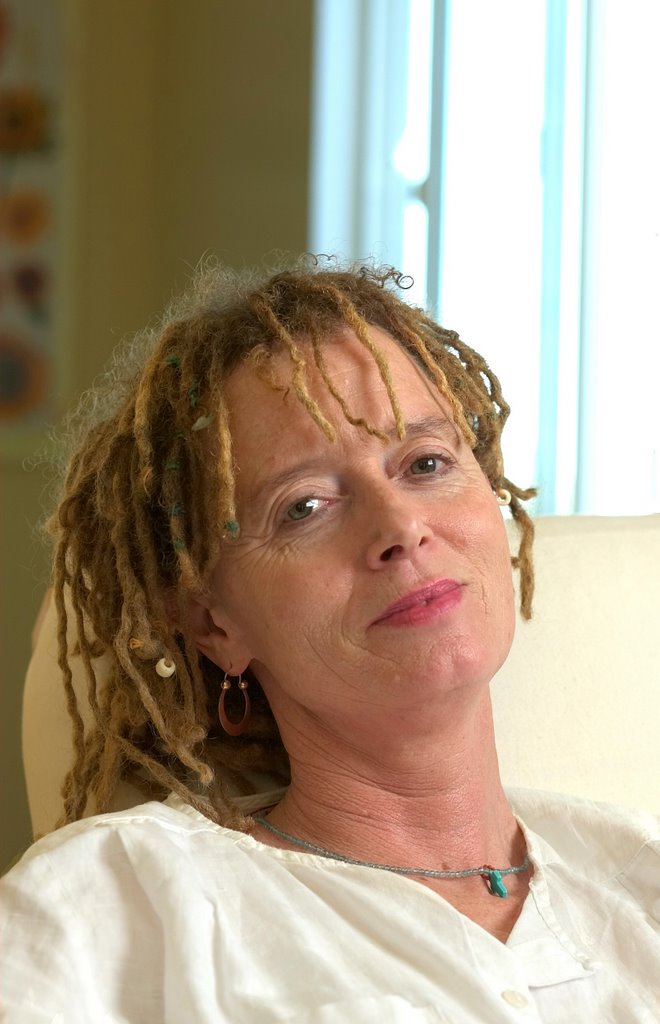
Tuesday, December 23, 2008

Books as Medicine

'I write because writing is the gift God has given me to help people in the world. I came with curly hair, green eyes, and the ability to shape and tell stories in a way that a certain kind of person finds helpful, and funny. I love to make people laugh, because nothing is more life giving. I love to help people feel a sense of connection in their lives, by sharing the truth and details of mine — this seems to greatly decrease people's feeling of isolation. I try to write the books I would love to come upon, that are honest, concerned with real lives, human hearts, spiritual transformation, families, secrets, wonder, craziness — and that can make me laugh. When I am reading a book like this, I feel rich and profoundly relieved to be in the presence of someone who will share the truth with me, and throw the lights on a little, and I try to write these kinds of books. Books, for me, are medicine.'
--The writer Anne Lamott, responding to the question "why do you write," put to her by Powell's bookstore in Portland, Oregon. You can review several earlier mentions of Lamott here. I've mentioned the sublime Powell's bookstore earlier, here.

Saturday, December 09, 2006

Finding the Roadmap
To Your Life in a Book

'I knew the day I read The Only Dance There Is that this was what I was going to do with my life: pursue spiritual truth and try to help people laugh as part of their healing path. Finding that book taught me a lesson about how truth comes to us in such quirky, unexpected packages, because it was one of the worst days of my life. It was Easter Sunday, probably in 1974, and I was lying in my adorable hippie boyfriend's bed with a stomach flu, and he had gone to be with his other girlfriend, what with us being so hip and all, and me not being much of a date for Easter dinner. When he left, I really felt like I would die from being so sick and alone and jealous. Then I picked up this book he'd been reading, and I felt like it was worth any price to feel so guided, understood, trusted and entertained, all at once. My soul was so hungry and thristy for Ram Dass's voice that I read the book in one sitting--or rather, in one lying, because I was sick in bed. I remember drinking this disgusting herbal tea all day--chaparral tea, which tastes like couch stuffing--because there wasn't anything else in his house. When I was done, I washed my face, brushed my teeth, put the book down by the side of the bed, and left. It was a great day.'

--Anne Lamott, from The Book That Changed My Life--71 Writers Celebrate the Books that Matter Most to Them. Earlier, I mentioned Lamott here and here. You can read an interview with her here, and read a sample of her essays here.

Friday, October 24, 2003

Things That Took My Head Off Today

My former Edition colleague and master book reviewer Kathy Ewing (click here and here for examples of her writing) once wrote an especially memorable column about how serious readers often have the experience of reading something so good and powerful and evocative that it almost gives you the sensation of having the top of your head taken off. Your brain actually aches after reading it. Depending on how much good stuff you read, you can go days, weeks or even months between these experiences. And then there are days like today, when it happened twice to me.

The first came in the early hours of the morning, when I rise before dawn (pretty easy to do in Ohio in October, before daylight savings pushes it one hour earlier), let the cat out and fire up the family Dell for my first quick survey of the day's news. I happened upon Salon, as I generally do, and took in Annie Lamott's latest. I've enthused about her before, but I'm duty-bound to do so again. That's because I found her latest column--of all things about the necessity to surrender to motherhood--so rich and so emotionally powerful as to take one's breath away. Please take a moment to go there today, figure out how to click on the free one-day visitor's pass in the upper right corner (which my tech-challenged buddy in New York, Bill Gunlocke, can never seem to do, prompting him to occasionally ask me to cut and paste an article into an email) and read her column.

A little later, while making a quick scan of the blogs, I came across this amazing entry on Lois Annich's uniquely graceful Hearts @ Work blog. Sorry, Lois, but out of concern for the possibility that some of you won't take a second to click on a link, I'm going to ignore your copyright just this time and reprint the small item in its entirety:

Despair is the absolute extreme of self-love. It is reached when a man deliberately turns his back on all help from anyone else in order to taste the rotten luxury of knowing himself to be lost. --Thomas Merton

Inspector Javert, the antagonist in Les Miz, is the most tragic figure among an ample field of tragic characters in the play. He cannot face the implosion of his graceless theology when his prey and obsession, Jean Valjean, offers him the gift of life. His logic is so twisted. He can no longer appease his bloodthirsty God and cannot release his old world view and receive reconciliaton. He takes his life instead. Admitting that we have been wrong is a major blow to our egos. We must be humble. We must release any number of self-images we have built up over time. We must be willing to receive forgiveness and move forward in hope. We must accept the support of others. As Merton reminds us, giving into despair is no sign of greatness. Greatness instead depends on humbly receiving grace and living our way into the promise of new life, if only one uncertain step at a time.


Of course, the things that take our head off when we read aren't due solely to the beauty or the power of the writing or to the truth of the thoughts they convey--thought that's of course much of it. They also work so explosively on the brain because they deal so well, and in such timely fashion, with the questions or challenges we're wrestling with, as if the article or the passage was written directly for you, almost in the form of a letter from a friend. And indeed, each of these passages helped me think more clearly about very specific challenges/initiatives I've undertaken. The Lamott piece related so beautifully to a new monthly dad's column that I'm beginning in January (which of course means I'm now beginning to write). And in my struggle to communicate not just to other dads of teenage boys, but to all parents and maybe even non parents, and hell, perhaps even kids, about some important themes about families and really about love, her column was pure inspiration, a welcome reminder of the universal appeal of good, honest writing. Though I'm not a single mom of a single kid, living in libertine Marin County, California, I nevertheless connected so deeply with the advice she gave, because it was great advice, artfully served up. And because it really applied to anyone trying to live a better, richer life, even apart from parenthood, the proximate subject.

Similarly, the Merton quote about the need to put aside our pride and accept help (letting community become a dialogue rather than monologue) dealt so specifically with some networking advice and support I'm providing with a new friend named Jeff, whom a headhunter friend referred to me, and whom I met with again this morning. As he comes out of the focused shell of a high-powered corporate job in a billion-dollar-plus company, where networking mostly meant with internal colleagues, I think he's been overwhelmed (as a fairly new to Cleveland guy) by how many smart, connected people in this town have been only too happy to take time and help him think about what comes next in his career. And yet as I offered to him whatever small help I can provide--and most importantly the very large help that my network of friends and colleagues can offer--I was forced to admit that I'm impossibly bad at accepting the reverse, the generous and repeated offers from others to reciprocate. While I'm okay at the "humbly receiving grace" from God part which Lois writes about, I'm less good at accepting that a key part of that grace comes in the form of warm human figures who generously offer to help.

Whether it's stubborn male pride or 20 years of baked-into-the-DNA writerly independence, or an especially toxic combination of the two, it doesn't really matter. Merton's quote, and Lois's artful and knowing annotation, somehow combined to break through my hard shell this morning, as I read these grace-filled letters directed at me while my precious family slept one floor above me. And for that, I'm so very thankful...

Wednesday, August 15, 2007

What Every Good Mentor & Teacher Knows

'And then learn to be more compassionate company, as if you were somebody you are fond of and wish to encourage. I doubt that you would read a close friend's early efforts and, in his or her presence, roll your eyes and snicker.'
--author Anne Lamott. To review my earlier mentions of this sublime word sculptor (some brief, others substantial), go here, here, here, here, here, here and here. And for the record, I fully agree with my friend Jeff Hess's assessment that her fiction doesn't begin to hold a candle to her essays and memoirs. But then, perhaps that's only because we're guys. And you know how clueless they can sometimes be.

Wednesday, February 11, 2009

Every Once in a While, You Just Have to
Stop the Chattering of the Rational Mind

'You get your intuition back when you make space for it, when you stop the chattering of the rational mind.'
--author Anne Lamott. You can review several earlier mentions of one of our favorite writers here (just click through for all of them).

Sunday, December 06, 2009

The Power of
Parental Focus

'I used to not be able to write if there was a dish in the sink. Then I had a child, and now I can write if there's a corpse in the sink.'
--the writer Anne Lamott, quoted in a documentary about her life. You can review our many prior mentions of the gifted one here.

Monday, August 17, 2009

Hope Begins in the Dark

'Hope begins in the dark, the stubborn hope that if you just show up and try to do the right thing, the dawn will come.'
--Anne Lamott. We've pointed to her often, for what I hope are obvious reasons. She's just damn brilliant.

Sunday, November 12, 2006

A Solid Month of Writing

The writer Anne Lamott is famous in some quarters for her suggestion on how to break through writer's block. "Just write a shitty first draft," she counsels, on the theory that once you have something to begin shaping, polishing and improving, everything gets easier. This month, thousands of writers are taking part in National Novel Writing Month, a group effort in diligently breaking through blocks by writing at least 50,000 words. My friend Jeff Hess is one of those taking part. I'm looking forward to his report on how it went. Meanwhile, this fine Washington Post article explains what it's all about. Wouldn't it be wonderful to live in a town with a paper that was all over this kind of story? I'm afraid that'll only happen if I move.

Friday, December 19, 2003

May She Find 100 Million Helpmates

"I am going on sabbatical, during which time I hope to help George Bush find employment for which his unique interests and training are better suited."
--Bay Area hippie theologist Anne Lamott, on why she's taking a break from her weekly column on Salon.com

Monday, June 16, 2003

The Commencement Speech

We've just been through the season of school graduations, and with it came the ubiquitous round of commencement speeches. Mostly, these little sermons are famous for their remarkable ability to be wholly unremarkable, to cause little in the way of audience expectations and generally to deliver even less. But of course there have been exceptions. Today, I bring you word of three. One is a 34-year mini retrospective from a future famous lady, and two others from a couple of my favorite writers.

Hillary Clinton is having something of a revival, now that her new book is out. (and save yourself $25, by the way, there's not much in it--here are the Cliff Notes). Anyway, that got me to wondering what it was she said in her very first brush with fame, her infamous 1969 commencement speech to her graduating class at Wellesley College. So pointed was it that it landed her on the cover of Life Magazine, presumably as a spokesperson for her generation. And so I looked it up on the web.

Unsurprisingly, it's full of all the things we've come to expect of Hillary in the years since--all the wacky, overreaching language ("we're searching for a more immediate, ecstatic and penetrating mode of living") and the remnants of the internal struggles resulting from upbringing by a coldly conservative Republican father and a quieter liberal mother. In any event, it's interesting reading.

In May, Anne Lamott, the Bush-hating, grace-besotted, recovering-addict, Christian-mystic, Bay-area genius of a writer gave the commencement address at the Left Coast's answer to Wellesley, the University of California at Berkeley. And she didn't disappoint, giving the kind of heart-felt emotional stemwinder of a talk whose seeming nihilism tends to electrify the graduates, horrify their parents and leave the university faculty and administration feeling perhaps a little of each. I'll quote from some of it, but for the entire thing, click on Salon here (you really oughta be registered for this pub--now that you can get a free subscription each day in return for watching a single ad).


I bet I'm beginning to make your parents really nervous--here I am sort of bragging about being a dropout, and unemployable, and secretly making a pitch for you to follow your creative dreams, when what they want is for you to do well in your field, make them look good, and maybe also make a tiny fortune. But that is not your problem. Your problem is how you are going to spend this one odd and precious life you have been issued. Whether you're going to spend it trying to look good and creating the illusion that you have power over people and circumstances, or whether you are going to taste it, enjoy it and find out the truth about who you are.

It's powerful stuff, and I recommend the entire address to you.

And finally, there's the Bill Zinsser '88 commencement address at Wesleyan University.
Some years ago, he sent me the manuscript, and I remember being moved at the time by its quiet power, similar to the quiet power of its author himself. Now that I'm also reading it as a parent, it seems even richer. And since it's not online, indulge me while I reprint the majority of it here:


The sportswriter Red Smith was one of my heroes. Not long before his own death he gave the eulogy at the funeral of another writer, and he said, 'dying is no big deal. Living is the trick.' Living is the trick. that's what we're all given one chance to do well. One reason I admire Red Smith was that he wrote about sports for 55 years, with elegance and humor, without ever succumbing to the pressure, which ruined many sportswriters, that he ought to be writing about something 'serious.' Red Smith found in sportwriting exactly what he wanted to do and what he deeply loved doing. And because it was right for him he said more important things about American values than many writers who wrote about serious subjects--so seriously that nobody could read them. Another story. When I was teaching at Yale, the poet Allen Ginsberg came to talk to my students, and one of them asked him: 'was thee a point at which you consciously decided to become a poet?' And Ginsberg said: 'It's wasn't quite a choice; it was a realization. I was 28 and I had a job as a market researcher. One day I told my psychiatrist that what I really wanted to do was to quit my job and just write poetry. And the psychiatrist said, 'why not?' And I said, 'Well, what would the American Psychoanalytic Association say?' And he said, 'There's no party line.' So I did. We'll never know how bit a loss that was for the field of market research. But it was a big moment for American poetry. There's no party line. Good advice. You can be your own party line. If living is the trick, what's crucial for you is to do something that makes the best use of your own gifts and your own individuality. There's only one you. Don't ever let anyone persuade you that you're somebody else. My father was a businessman. His name was William Zinsser, and he had a business called William Zinsser & Company that had been founded by his grandfather, also named William Zinsser, who came to New York from Germany in 1849 with a formula for making shellac. He built a little house and a little factory way uptown at what is now 59th Street and Eleventh Avenue. I have an old photograph of those two buildings, all alone in an open field full of rocks that slopes down to the Hudson River. That business stayed there until 15 years ago--a 125 years. It's very rare for a business to stay in the same family on the same block in mid-Manhattan for a century, and I can assure you that it builds a sense of family continuity. One of the most vivid memories of my boyhood is how much my father loved his business. He had a passion for quality; he hated anything second-rate. Seeing how much he loved his work and how good he was at it, I learned very early what has been a guiding principal of my life: that what we want to do we will do well. The opposite, however, is also true: what we don't want to do we won't do well--and I had a different dream. I wanted to be a newspaperman. Unfortunately, my father had three daughters before he had me. I was his only son. He named me William Zinsser and looked forward to the day when I'd join him in the business.(In those Dark Ages the idea that daughters could rn a company just as well as sons, or better, was still 20 years off). It was a ready-made career for me--lifelong security--and maybe I also owed it to my mother and my sisters to carry on that hundred-year-old family tradition. But when the time came to choose, I knew that that just wasn't the right thing fo rme to do, and I went looking for a newspaper job, and got one with the New York Herald Tribune, and I loved it from the start. Of course, that was a moment of great pain for my father--and also for me. But my father never tried to change my mind. He saw that I was happy, and he wished me well in my chosen work. That was by far the best gift I ever received, beyond price or value--partly, of course, because it was an outright gift of love and confidence, but mainly because it freed me from having to fulfill somebody else's expectations, which were not the right ones for me. The Herald Tribune at that time was the best written and best edited newspaper in America.The older editors on that paper were the people who gave me the values that I've tried to apply to my work ever since, whatever that work has been. They were custodians of the best. When they made us rewrite what we had written and rewritten, it wasn't only for our own good; it was for the honorableness of the craft. But the paper began to lose money, and the owners gradually cheapened their standards in an effort to get new readers (which they therefore couldn't get), and suddenly it was no longer a paper that was fun to work for, because it was no longer the paper I had loved. So on day I just quit. By then I was married and had a one-year-old daughter, and when I came home and told my wife that I had quit she said, 'what are you going to do now?' which I thought was a
fair question. And I said, 'I guess I'm a freelance writer.' And that's what I was, for the next eleven years. It's a life full of risk: the checks don't arrive as often as the bills, or with any regularity. But those 11 years were the broadest kind of education; no other job could have exposed me to so many areas of knowledge. Also: In those eleven years I never wrote anything that I didnt' want to write. I'd like you to remember that. You don't have to do unfulliflling work, or work that diminishes you. You don't have to work for people you don't respect. You're bright enough to figure out how to do work that you do want to do, and how to work for people you do want to work for.
Near the end of the '60s my wife said she thought it might be interesting to live somewhere besides New York and see what that was like. Well, to suggest to a fourth-generation New Yorker that there's life outside New York is heresy. But I began to discuss the idea with friends, and one of them said, 'you know, change is a tonic.' I didn't know that. I was afraid of change; I think most people are. But I seized on the phrase 'change is a tonic' and it gave me the energy to go ahead. I had always wanted to teach writing: to try to give back some of the things I had learned. So I started sending letters to colleges all over the country--big colleges, small colleges, colleges nobody had ever heard of, experimental colleges tha I actually went and visited; one was in a redwood forest in California and one seemed to be in a swamp in Florida--asking if they had some kind of place for me. And they didn't, because I was not an academic--I only had a BA degree, like the one you'll have in about five minutes--and it was very discouraging. But finally one thing led to another. It always does. If you talk to enough people about your hopes and your dreams, if you poke down enough roads and keep believing in yourself, sooner or later a circle will connect. You make your own luck. Well, one thing led to another, and one day I got a call from a professor at Yale who said he would take a chance and let me teach an experimental writing course for one term (by the way, that was almost two years after I had started sending all those letters). And on that slender thread we sold our apartment in New York and moved to New Haven, a city we had never seen before, and started a new life. Yale was totally generous to me, though I was a layman from out of nowhere--a journalist, god forbid. I was allowed to initiate a nonfiction writing course, which the Yale English department later adopted, and I was also allowed to be master of one of Yale's residential colleges. So those were rich years for me--years of both teaching and learning--because they were unlike anything I had done before. Now the fact that Yale let me do all this is the reason I'm telling you the story. I didn't fit any academic pattern. But finally, being different was not a handicap. Never be afraid to be different. Don't assume that people you'd like to work for have defined their needs as narrowly as you think they have--that they know exactly who they want. What any good executive is looking for is general intelligence, breadth, originality, imagination, audacity, a sense of history, a sense of cultural context, a sense of wonder, a sense of humor, far more than he or she is looking for a precise fit. America has more than enough college graduates every year who are willing to go through life being someone else's precise fit. What we need are men and women who will dare to break the mold of tired thinking--who just won't buy somebody saying, 'we've always done it this way. This way is good enough.' Well, obviously it's not good enough or the country wouldn't be in the mess it's in. I don't have to tell yo all the areas where this wonderful country is not living up to its best dreams: Poverty. Inequality. Injustice. Debt. Illiteracy. Health care. Day care. Homelessness. Pollution. Arms-spending that milks us of the money that should be going into life-affirming work. There's no corner of American life that doesn't need radically fresh thinking. Don't shape yourself to a dumb job; shape the job to your strengths and your curiosity and your ideals. I've told you this story of my life for whatever pieces of it you may have wanted to grab as it went by... If I had to sum up why my work has been interesting it's because I changed the direction of my life every eight or nine years and never did--or continued to do--what was expected. I didn't go into the family business; I didn't stay at the Herald Tribune; I didn't stay in New York. And I didn't stay at Yale. In 1979 I made a resume, like every Yale senior (they showed me how to do it--how to make it look nice), and went job-hunting in New York, and got a job with the Book-of-the-Month Club, which was still another new field for me, and in many ways those eight years were the most interesting years of all. So don't become a prisoner of any plans and dreams except your own best plans and dreams. Don't assume that if you don't do what some people seem to be insisting that you do, in this goal-obsessed and money-obsessed and security-obsessed nation, it's the end of the world. It's not the end of the world. As my experience with my father proves, something very nourishing can happen--a blessing, a form of grace. Be ready to be surprised by grace. And be very wary of security as a goal. It may often look like life's best prize. Usually it's not....For you, I hope today will be the first of many separations that will mean the putting behind you of something you've done well and the beginning of something you'll do just as well, or better. Keep separating yourself from any project that's not up to your highest standards of what's right for you--and for the broader community where you can affect the quality of life: your home, your town, your children's schools, your state, your country, your world. If living is the trick, live usefully; nothing in your life will be as satisfying as making a difference in somebody else's life. Separate yourself from cynics and from peddlers of despair. Don't let anyone tell you it won't work. Men and women, women and me, of the Wesleyan Class of 1988: There's no party line. You make your own luck. Change is a tonic. One thing leads to another. Living is the trick. Thank you.


Friday, March 28, 2003

Ten Commandments

Thought to frame the day:
"Hope is costly, as Augustine said, but not as costly as giving up."
--Anne Lamott, author of "Bird by Bird," "Traveling Mercies" and other unforgettable works
.


The excellent story on Google in the new (April) Fast Company Mag. has put to rest, for now at least, my concerns that the magazine's new owner--a mildly clueless, blandly rapacious German publisher--would quickly kill their jewel. There's at least hope now that they'll only slowly kill off what made it special and unique, in the meantime giving us time to at least give it a decent burial. The two visionary ex-Harvard Business Review founders have been patted on the head and given the magazine equivalents of academia's emeritus title, while the rest of us are left to hope that, like the Jesuits and their universities, these two inspired gurus have been able to inculcate sufficient fervor in their proteges to carry on their work even when the clerical collars are fewer and further between. Anyway, the Google story is full of solid reporting and great insights that both say something new about a much-covered company AND provide some take-away clues that nearly anyone could apply to their own situation. I recommend it.
It recalls for me the very story that first made me sit up and take notice of the magazine. Still had the hard copy in my files, and I've reread it occasionally, and been impressed by how true it was at so very early a juncture--summer of '96, even if it was steeped in the then-recent success of Netscape.
Its title is Ten Commandments for Success on the Net, and for a lot of people it introduced new terms such as "strategic generosity" and well-articulated ideas such as this: "Nets punish ruthlessly any attempt to control how they want to evolve..." But maybe the two most important commandments for me were Generosity Begets Prosperity (a deeply counterintuitive, even paradoxical idea for a lot of people) and No One is As Smart As Everyone. I was pleased to find it still available in the FC archive. You'll find it at: http://www.fastcompany.com/online/03/command.html# (we'll get this damnable blogger linking command working yet. George?).
--John Ettorre

Tuesday, October 07, 2008

Deanna Marks 25th Annual Lakeland Fest
With Touching Salute to Her Writing Roots

For many years, my friend Deanna Adams has organized a twice-annual writers conference at Lakeland Community College, picking up the torch from its founder, and her mentor, the late Lea Leaver Oldham. At this year's 25th annual event, held last month, Deanna marked the occasion with a touching tribute to all the things that helped make her the writer she is today. We thought it was a particularly moving evocation of the many sources of support, inspiration and encouragement that go into the formation of a writer, and so we bring you her entire presentation. If you enjoy this half as much as we did, we hope you'll consider stopping by her site and sending her some love.

In September of 1983, I was a newly married 29-year-old (my own 25th anniversary had been two months ago), just beginning to realize my dreams of being a “real” writer. Ever since I was a kid, I had visions of sitting at the typewriter cranking out fascinating prose, writing dramatic stories, and imparting wonderful bits of wisdom. I wrote little plays and children’s books in elementary school. And dreadful poetry in my teenage angst years. And then, in my early 20s, decided I need some real guidance. So I enrolled here at Lakeland and signed up for a Creative Writing class and met my first mentor, Mr. Gene Dent. He taught in an interesting manner, and boy, he knew his stuff. He then encouraged me to take the journalism classes he was also teaching. So I did.

Now, to back up a bit, I must confess - I was not a good student in high school. As a matter of fact, my mother often said I must really like my initials, DF, because she saw them so often on my report cards. That of course was partly due to my “rebel stage” but it was also because I never had a teacher who really encouraged me to do better. Most wrote me off as someone just getting by. Probably won’t amount to much. And I began to believe that.

But then I took Journalism 101 with Mr. Dent. And that’s when my writing life changed. When he handed back that first assignment, I was thrilled to see I got a B- on it! But then there was a note at the bottom where he wrote “See me after class.” Oh-oh. (I wasn’t unfamiliar with that phrase). And this is what he told me. “You really have a way with words,” he said. “And I know you can do better than this. So I want you to do it over. I want you to polish up the lead. Give me a little more detail about the subject. And watch your run-on sentences (which, incidentally, I am still known for – and interestingly, many of the great contemporary writers do it all the time now, so it appears I was simply ahead of my time). Mr. Dent then told me he’d re-grade it.

Wow. Here, I was really happy with the B-. But he thought I could do even better! And because of his faith and confidence in me, I wanted to prove him right. I did it over, paying attention to everything he’d told me. When he handed it back to me the second time, I saw a big red A. And in his class, and under his direction, I saw many A's after that. And while taking all the required courses for my Associates in Arts degree, I continued taking creative writing courses each and every semester. And of course, joined the staff on the Lakelander, the college newspaper. Soon Mr. Dent suggested I apply for an internship at the News-Herald. And that’s when I met my second mentor. Janet Podolak, who was then, and still is now, the best writer that paper has ever had. And I don’t care if someone tells that to Jim Collins . . . It’s true.

As my editor, she took me under her wing, and while I first had to write up a lot of dry pieces like “Tip of the Hat,” the events calendar, and I think an obit or two, Janet began assigning me real features. And just about a month later—after telling her I was going on vacation—she told me to take notes, and photos, and I could write about my experience in a feature for the Sunday edition. Are you kidding me? I’d never written a travel piece, and with all those details and description you need . . . I didn’t think I could pull it off. But again, she thought I could. Soon as I got back, she and I worked on the piece together. I learned so much. And I tell you, seeing your words in a big Sunday feature on the front page of the travel section - or any section - is absolutely thrilling - and addicting. It had been a lot of work. But I couldn’t wait to do it again. And again. I stayed at the News-Herald writing pieces for free, long after the other interns had left.

My first piece of advice to those of you just starting out: If someone gives you an opportunity to write for publication, even if it’s a church bulletin, do it! Don’t ask how much they’ll pay you. You’re getting paid in experience. And the more you do it, the more confident you’ll become, and the better writer you’ll be. And you’ll also, then, have writing clips to show future editors who will pay for your work. That internship was in 1981. In the winter of ’82, I met my third mentor, Lea Leever Oldham, the founder of this conference. Now she was a real pistol. I’d never met anyone like her before or since. She had the confidence, the wisdom, and the gumption (and dramatic flair) I could only dream of having. I took a couple of her classes, and one day, she came up to me at the end of one and said, “You’re coming to the writer’s conference I’m having, aren’t you?” Now anyone who knew Lea, knows that tone of voice she often used. It was not a question.
I was going to the conference.

I’m often told by aspiring writers how lucky I am to have had not one, but three mentors in my career. But this was no lucky accident of fate. I made myself be at the right place, at the right time, with the right people. You can’t meet mentors in any business without being where those mentors - those teachers – are. So go to where writers hang out. Be it in a classroom, an author reading, or coffee shop. I’ve also had aspiring writers say, “Well I love to write, but right now, I just can’t afford to take any writing courses, or go to a conference or workshop.” Believe me, I know where they’re coming from. As a young divorcee in my late 20s, I was working two jobs and still struggled to pay the rent, and all else that goes with making a living. But there are ways to get to where you want to be if you want it badly enough, you don’t have to have a lot of money to do it.

But you do have to have determination, and you must be willing to sacrifice for it. I wanted to be a writer badly enough.

So I decided I didn’t need a new blouse or earrings, and I could make do with those old shoes (just shine ’em up a bit), and bought a lot of generic products. And I saved up a couple dollars each week for the next class I wanted to take. And I practically lived at the library – after all, it’s FREE. I read all the kind of books that I wanted to write. And I studied them – paying attention to how they began, how the stories – Fiction or Nonfiction - connected, how they were organized chapter by chapter. And I read - and studied - tons of books on writing. I took out all the writing magazines available – like those out there on the conference table. (Which, today, is also Free). And I went to that conference – Lea Oldham’s First Western Reserve Writers Conference, 1983. And I went to nearly every one after that. Including the Spring ones, which she began later.

This leads to my second piece of advice. Invest in yourself. No one cares more about your future than you do. No one cares more about you becoming a writer than you do. No one will help you become a good writer more than those who have been there, right where you sit today. But you have to be Determined. You have to Sacrifice. And You have to Get A Little Help From Your Writer Friends . . . If you don’t have any writer friends, it’s because you haven’t yet been to a writing class, a writers’ conference, or a local book signing. You haven’t been to where writers - and their mentors - hang out.

But you are today. So I know every one of you has that determination. And probably more than a few of you had to sacrifice a bit to be here today. Be it by saving up a little money, or getting your husband, mother, sister or brother to watch your kids. (Been There!) But trust me on this: By the end of today - The First Day of the Rest of Your Writing Life as you rejoin me in this room for refreshments and the Q and A Panel, you will agree with me that it has been worth every penny, and a few sacrifices. And that this is still the best deal for writers in town – or probably anywhere. Because thanks to the founder of this conference, who knew what it’s really like to be a writer, you will gain concrete and useful information, insight, inspiration, and yes, a new writer friend or two.

Along the way to my writing life, I worked hard at developing my skills, and soaking up as much information as possible, so I could be a GOOD Writer (as opposed to Being a BAD writer, and believe me, just because you are published, doesn’t always mean you’re good), and so I made sure I learned from the best. I accumulated Literary Heroes. Great writers who, by merely reading their work, I learned so much from. Like William Zinseer. And Mary Karr. And David Sedaris. Frank McCourt. Anne Lamott. Susan Issaacs. And Elizabeth Berg. Even old guys like Ernest Hemingway and F. Scott Fitzgerald, E. B. White, and Sherwood Anderson. And of course literary women of long ago: Willa Cather, and Flannery O’Connor, Katherine Mansfield. I know a few on that list, some of you may never have heard of. You see, not all the well known “great” writers have done it for me. Their work didn’t touch my soul, for whatever reason. You have to read a lot to acquire your own personal literary heroes, and they don’t have to always be the best sellers.

This is just MY list – You go get your own.

And there is also My Local Literary Heroes List - and that keeps getting longer and longer - which gives you an idea how lucky we are to be living in the Greater Cleveland area, where I swear there must be something in the water when it comes to the Arts – any of the Arts. To add to my Literary Heroes, I don’t have to go any further than my own hometown. There is Connie Schultz and Regina Brett, and Joanna Connors – all in one newspaper! There is Michael Ruhlman, and Sarah Willis, and Les Roberts. There is Michael Salinger, and Erin O’Brien, and Michael Heaton and Scott Lax. There is John Ettorre and Ray McNiece, and of course my old mentor, Janet Podolak.

I am so proud to call each and every one of these talented writers who produce such great work in Northeast Ohio, my friend. And whenever I happened to be mentioned in the same breath as them (ok, not all that often, but it has happened!) I feel so honored, and so humbled. And it makes me want to work hard enough to have actually earned that mention.

And that’s why we need a Little Help from Our Writer Friends. They help us aspire to be like them. To strive to write even better than them. So there’s a chance that someday, we can be mentioned in the same breath as them. And be as supportive of them as they are to us. Because they are actually willing to help us by teaching us. Or merely by taking the time to talk to us at their book signings, about how they do it. We need these writer friends. We need them when we, finally, get our work published. We need them when we receive that 100th rejection letter. We need them in the beginning of our career. And in the middle of our writing trenches. And certainly at the end, when we’ve completed that long project of writing a book and are, finally, the ones sitting at that book signing – praying someone will buy our book, or at least not ask us where the latest Stephen King novel is – Because they think we work there (oh, yeah, ask any author, it happens!).

I have indeed learned from the best. My writing mentors. My writing colleagues. My writing friends. This is what I’ve learned from them:
1) Don’t FIND time to write – because you never will. You have to MAKE the time to write.
2) Learn the art of writing by:
A) Taking Classes, workshops, and conferences such as these.
B) Learn by doing. Sit in that chair and write as if your life depends on it. You’ll be amazed what comes through if you just sit and write and write, and keep at it.
C) READ. READ. READ. Not just for pleasure, but to see how it’s done!
Stephen King said it best: If you don’t have the time to read, you don’t have the time or the tools to write.” Those are key words – TIME. TOOLS. The Tools are seeing how the writer makes sense of it all. How the prose comes together. How it all WORKS.
3) Support other writers – After all we’re in this together. Go to their book signings, attend their workshops. Go see them when they give a Presentation. Ask them questions. Tell others about them and their work. Read a Good Local Book Lately? – SPREAD THE WORD!
4) And finally, make writer friends. This is why, as of today, I’m reintroducing something that my mentor, Lea, always did at her conferences. These little stickers to put on your name tags – Yellow for Fiction, Pink for Nonfiction, Green for Poetry and Children’s Writing? This way you can see immediately what those next to you are writing. Seek out those whose writing interests are similar to yours. Talk to them, discuss your craft, commiserate over your rejection letters (and I believe you’re not a real writer until you’ve received your share of them b/c that means you’re at least sending your stuff out). Exchange emails with them, meet them at coffee houses. Form your own writers group.


Because we need each other. We are each other’s mentors, co-conspirators, and yes, friends. Because those other people out there? The NON-writers? They don’t have a clue what we writers have to endure. The Blood, Sweat, and Tears. And Fears – oh, most certainly that!

Those ones, the ones who aren’t writers? They think we do it because “We like to write” and “It’s such a nice “Hobby” and “You’re so lucky to be able to just sit at home and write in your pajamas . . .” They just don’t get it. We don’t do it because we like it or merely because we want to – though there is that. We real writers do it because we have to. We really have no choice. And only you, the real writers here, know just what I’m talking about.

So Folks, Here’s to another 25 years of Learning How to Do It.